

While the majority of murdered victims of the 1984 genocidal massacres were Sikh men and sexual violence victims, women and girls, there were many recorded incidents of attacks on children.
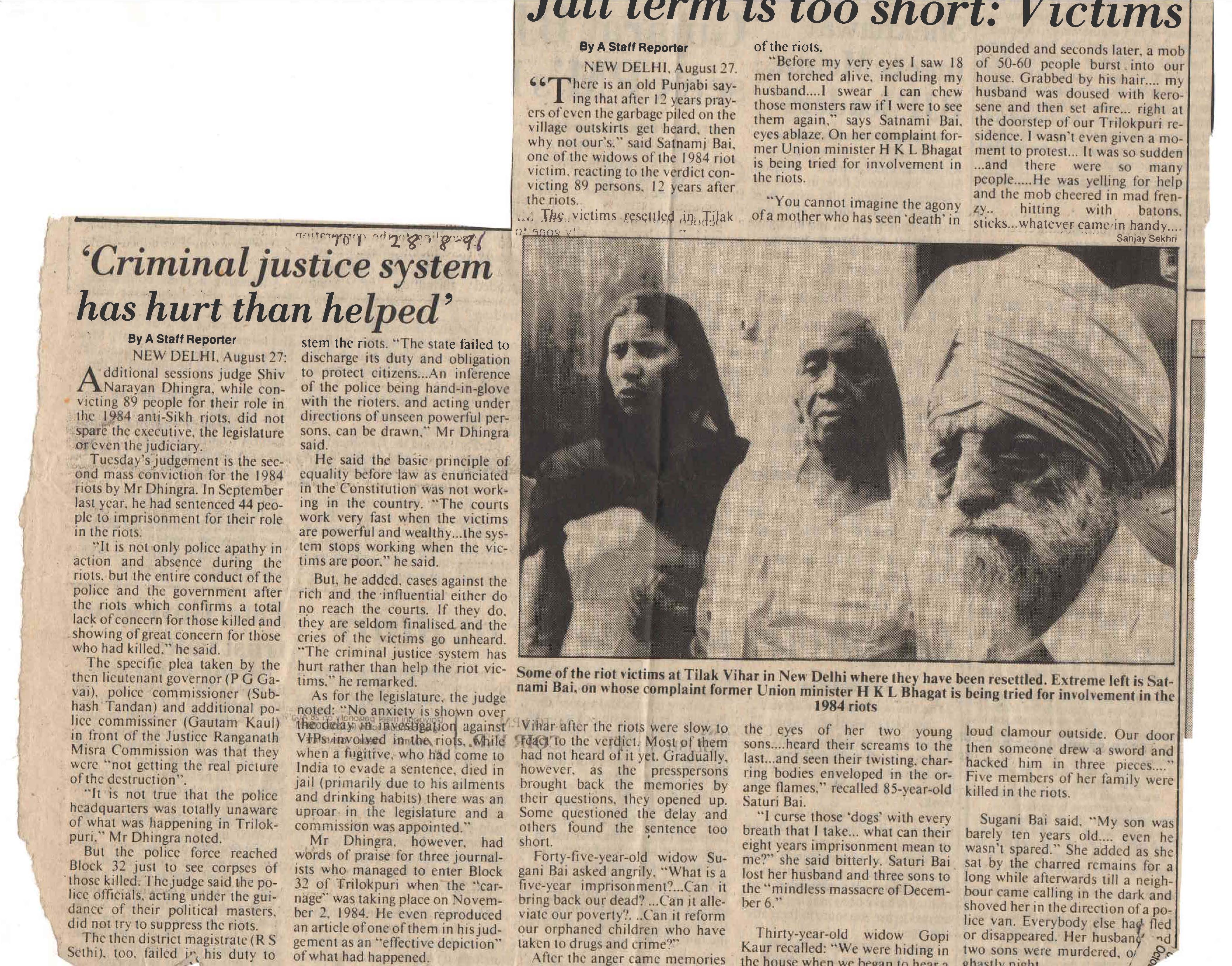
“My son was barely ten years old… even he wasn’t spared.“
Sugani Bai, whose husband and two sons were burnt alive.
Criminal justice system has hurt than helped. Indian Express. 27 August 1996.
“We saw a child of about ten, dressed in a salvar kameez [a traditional female suit dress], who was moving on the road. The child was walking quite normally down the street. He was actually a young boy in the process of fleeing to safety and had been dressed as a girl.
Something about the child’s appearance made the mob suspect that the child was a boy and someone shouted ‘he must be the son of a Sikh’. The child panicked and started running but the mob pursued him and caught him. They asked him where the other members of his family were. The boy was really frightened and he pointed in a certain direction and said that his father was lying there and that he was dead. To my horror the mob dragged the boy up to the father’s body, threw the child on him and burnt him, saying ‘this is the son of a snake, finish him off too”.
Interview of a survivor who had witnessed this attack from the safety of their hideout.
Recorded by Dr. Uma Chakravarti and Nandita Haksar
In Pataudi, a town in the Gurgaon district lying approximately seventy kilometres south-west of Delhi. On 2 November 1984. A witnessed recalled:
‘The mob dragged Harmeet Kaur, 16, and Karamjeet Kaur, 19 out into the street, stripped them, abused them, beat them, urinated on their faces and burnt them alive.
There was no sense of human dignity, no sense of compassion. What role did these girls have in Mrs Gandhi’s assassination? Were we all responsible? Sardaron ke bachche hai, tho marao (They are children of sardars, so kill them).”
Gurjeet Singh, Pradhan (Gatekeeper) of Pataudi’s Gurudwara Singh Sahib
Veteran Indian journalist, Pranay Gupte, reported:
“Some Sikh children were castrated and their genitals stuffed into the mouths of their mothers and sisters.”
Pranay Gupte, Mother India: A Political Biography of Indira Gandhi, 2009, p 76.
In Vinod Nagar East, a few kilometres north of Trilokpuri, a truckload of men from nearby villages first razed Sikh shrines to the ground before moving on to people’s homes. The local postmaster’s house was set ablaze with his children inside. A local cinema owner’s home was also torched despite being just a stone’s throw away from a police station – four policemen were present at the time of the attack in which all eleven family members, including women and children, were roasted alive.1
A sworn affidavit from widow, Balwant Kaur of West Sagarpur stated:
“The two heads of two sons of my sister-in-law, who had been killed earlier at the back of our house were separated from their bodies and kept in the eating plates that had been thrown out. They even desecrated the dead bodies of our children. They did not permit us even to pour water in the mouths of our dying children.”
Affidavit of Balwant Kaur, submitted to the Misra Commission 1987.2
“One studio technician of a gospel-inspired radio station spoke of gangs relentlessly beating, stabbing and burning alive over a hundred Sikh men in his district, and the chopping off the fingers of women and children.”
John Fear, Exclusive Pedigree: My life in and out of the Brethren, 2016.
At Bokoro Steel City, in eastern India that was in Bihar but presently in Jharkhand, an entire family were killed:
“That thereafter the miscreants broke open the door of the house and started dragging out my mother, younger brother, father, elder brother and brother-in-law above mentioned.
That all the victims were dragged to the open compound outside the room. I saw that two persons had my younger brother, Kuljit Singh [age 16] caught firmly, and they were asking other miscreants to bring the spear to kill him. My brother-in-law is a clean shaven Sikh. Kuljit Singh cried for help to his mother, but the mother wept bitterly and so much choked that she merely looked at her son helplessly. I heard his cry for a few minutes and the miscreants started beating the boy mercilessly before his parents and brother and brother-in-law.
All of a sudden, the miscreants pounced upon all the five persons i.e., my mother, father, elder brother, younger brother and brother-in-law and started beating them with all parts of weapons on which they could lay their hands upon. All the five victims aforesaid fell dead.”
Affidavit of Jasbir Kaur submitted before the Misra Commission
In one locality, in the outskirts of Delhi, a reporter capture a group of Sikh women and children taking refuge in a wooded park (left), while a group of men watch on beyond a perimeter fence (right).


Narinder Singh from the Gammon Colony in Chas in the Bokaro district of the eastern state of Jharkhand recalls the attack on his family, including his 17 year old sister:
“The next to be attacked was my younger sister Jagjit Kaur (aged about 17 years) who was a student of Chas Kanya High School, Chas, studying in class X). A long knife was thrust into her neck which caused a deep cut and a stream of blood flowed from it. she instantaneously fell down, but the aforesaid criminals continued to hit her till they were sure that my helpless sister was dead.”
Affidavit of Narinder Singh submitted before the Misra Commission

A mother holds her toddler child whose lower body suffered burns. Brian Hanrahan report, BBC.
Charanjit Kaur witnessed her two newborn twins being tossed in the fire and burnt alive by a mob in front of their home in Sultanpuri on 2 November.2
In the Haryana village of Hoondh, mobs arrived from the neighbouring market town of Haily Mandi, near Pataudi on 2 November. The Gurdwara and Sikh homes were set on fire and then a horror unfolded:
“Men and children were beaten and thrown into the burning houses. Women were first raped and then thrown into the fires. Nobody came to claim the corpses. The local police conducted a mass funeral for the dead. But their ashes were never claimed and were thrown instead either into the nearby well or into the neighbouring fields.”
Wazir, Sanam Sutirath. The Kaur of 1984 – the untold, unheard stories of Sikh women. HarperCollins, 2024.
Children and babies were not spared from the violence that engulfed the Sikh community in November 1984.
Tweet