

With the state-owned TV1 and radio airing hate speech2 and ignoring the reality of what was taking place, it fell on the print media to report on the violence yet their coverage was minimal. The Indian Express did, however, report on the violence but on the orders of the Editor, the mass rapes were suppressed.3
In the vacuum, human rights groups, like the Nagrik Ekta Manch (Citizen’s Unity Forum), the People’s Union for Civil Liberties (PUCL) and the People’s Union for Democratic Rights (PUDR), worked tirelessly to document the killings as well as social activists who took down the testimonies of the women who had been raped.
The Indian government was quick to apply its powers of censorship against material deemed politically too sensitive. One of the earliest targets was monthly political magazine, Surya, founded by Maneka Gandhi, Mrs Gandhi’s Sikh daughter-in-law. When it published a stark front cover of three burning Sikh corpses, the Home Ministry ordered the removal of all copies from newsstands the day they appeared.4
The authorities were effectively clamping down on the reporting of what it deemed ‘inflammable material’ that could ‘excite passions in the country’.
You have your right, but if you are doing something that is sensitive, we have a right to prevent it
Indian Home Secretary, M. M. K. Wali rationalising the government’s tough stance to a gathering of international journalists, reported in New York Times, 7 November 1984.
On 6 November 1984, while maintaining that the allegations that their members were involved in the violence was ‘utterly malicious’., the government, anticipating further bad press, the government banned both Indian and foreign journalists from entering the relief camps.5
On 12 November, the government, increasingly worried about the reaction in Punjab, decided to ban all periodicals, newspapers or leaflets carrying any news of the killings and rapes in the capital and the rest of the country.6 When journalist James Mann of The New York Times travelled to Punjab to interview people, he was arrested, threatened with lengthy imprisonment and his equipment confiscated.7
Soon after the massacres had taken place, the People’s Union for Civil Liberties (PUCL) and the People’s Union for Democratic Rights (PUDR) released the report Who Are The Guilty, which catalogued the crimes that had taken place and who was responsible. It was later translated into Punjabi and released by the Association for Democratic Rights. When a second Punjabi edition was released in February 1985, it was duly banned in Punjab, which was then under president’s rule. Its publisher, Professor Jagmohan Singh, was charged for ‘waging war against the nation’. To date, it remains a banned publication in the Punjab.8
In 1987, the Indian High Commission in London attempted to ban British author Salman Rushdie’s Riddle of Midnight documentary as it featured the testimonies of the widows and called out government complicity in the massacres.9

During the production of this particular segment, Rushdie was taken aback by the behaviour of the Indian authorities – they went to great lengths to prevent his crew filming any of the widows or any scenes related to the massacres that had so blighted their lives.
Fortunately, an audio recording was made and used in the final cut. In lieu of video footage, a series of still images of several widows was used in a montage, which Rushdie felt was, if anything, ‘even more powerful than the moving image would have been’.10
When the Indian High Commission in London realised that Channel 4 were planning on airing the documentary which included the widow’s testimony, it reacted angrily and attempted to prevent the broadcast. At the time, the commission was headed by none other than P.C. Alexander, former Principal Secretary to Mrs Gandhi and her son, Rajiv. Channel 4 stood its ground and the broadcast went ahead without any cuts.
The veteran author, Khushwant Singh would, years later, when reflecting on the aftermath of the violence he had witnessed, recalled the heavily-biased reporting in the Indian press, opining how N. C. Menon, who succeeded him as editor of The Hindustan Times, had asserted that Sikhs ‘had it coming to them’.11 Equally extreme, thought Khushwant Singh, was Girilal Jain’s editorial in The Times of India, in which he was able to rationalise the violence, since ‘the Hindu cup of patience had become full to the brim’.12
In 2005, The Indian Censor Board forced cuts in the film, Amu, directed by Sonali Bose who had worked in the relief camps.13 The film depicted the events of November 1984. The film told the fictional story of a young woman discovering how her own family had suffered during the massacres. The release was initially delayed for three months while the Indian Censor Board went through it with a fine-tooth comb, finally passing it for release in December 2004. However, five lines of audio referring to the complicity of politicians and police were cut from the film and a member of the censor board, the actor Anupam Kher, was reportedly dismissed for initially passing it. The film was eventually given an ‘A’ (adult only) certificate by the censors.14

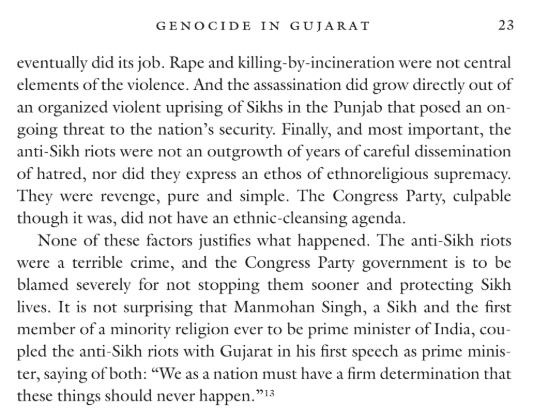
In 2007, American philosopher of law and ethics at the University of Chicago, Professor Martha C. Nussbaum, made the erroneous claim in 2007 that:
‘Rape and killing-by-incineration were not central elements of the violence’ in 1984.
Martha C. Nussbaum, The Clash Within: Democracy, Religious Violence, and India’s Future, 2007, p 23.
Our party has apologised to the Sikhs even before. I want this matter to be buried. It happened 20 years back and why should it be raked up again?
R. K. Anand, Senior advocate who defended the accused.
He became a Congress party candidate for South Delhi in 2009.
How coverage of the 1984 Sikh Genocide was censored, at the time and since.
Tweet
- Shanti Bhushan, ‘Affidavit’, Justice Nanavati Commission of Inquiry, 2005. ↩︎
- Justice Ranganath Misra Commission of Inquiry, Misra Commission Report,1987. ↩︎
- Sanjay Suri, 1984: The Anti-Sikh Violence and After, 2015, p 201 ↩︎
- Jaskaran Kaur, Twenty Years of Impunity, 2006, p 72. ↩︎
- James M. Markham, ‘Rajiv Gandhi and Sikhs meet and he offers reassurances’, The New York Times, 7 November 1984. ↩︎
- Rajiv Gandhi, in speech to nation, pledges a continuity of policies’, The New York Times, 13 November 1984. ↩︎
- ‘A Canadian reporter is arrested in Amritsar’, The New York Times, 12 November 1984. ↩︎
- Amaninder Pal Sharmal, ‘30 years on, book on 1984 victims still banned’, The Times of India, 3 February 2014. ↩︎
- James Endrst, ‘A look at the mystery of India’s independence: Rushdie’s ‘riddle’ unfolds in documentary,’ Los Angeles Times, 7 July 1989. ↩︎
- Salman Rushdie, Joseph Anton, 2012, p 84. ↩︎
- Khushwant Singh, ‘Oh, that other Hindu riot of passage’, Outlook, 15 November 2004. ↩︎
- ibid ↩︎
- Sumit Bhattacharya, ‘If Fahrenheit 9/11 can, so can Amu’, Rediff, 10 January 2005. ↩︎
- Someswar Bhowmik, ‘Film censorship in India: Deconstructing an incongruity’, in Indian popular cinema: a narrative of cultural change eds K. Moti Gokulsing and Wimal Dissanayakepp, 2004, p 309. ↩︎