

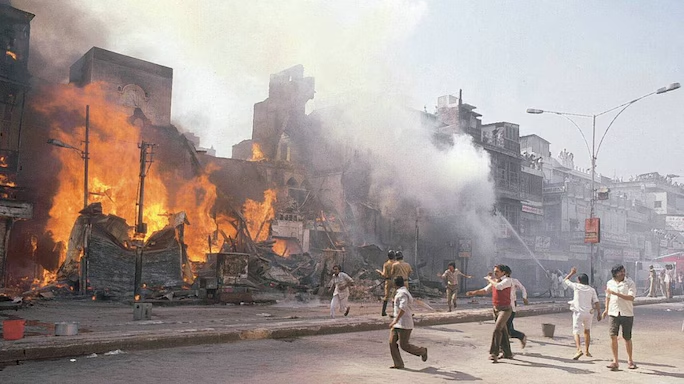
Early in the morning, organised mobs are transported in buses and trains from outside Delhi and begin descending on Sikh neighbourhoods. They are equipped with firearms, iron rods, knives, clubs, and an abundant supply of kerosene. Sacks of white phosphorous powder have also been procured and provided. Local Congress (I) politicians and police are seen directing the action. A four-day orgy of targeted violence has begun.


In a calm, emotionless voice, he [Rajiv Gandhi] said India had lost a great leader. Someone who was not just his mother but the mother of the country, or words to that effect. Then he stopped and stared sadly at the camera while Doordarshan showed shots of H. K. L. Bhagat and his supporters beating their breasts and shouting, ‘Khoon ka badla khoon se lenge.’ ‘Blood will be avenged with blood’.
Tavleen Singh, Durbar, 2012, Chapter 12: Rajiv.
The Home Minister, Lt. Governor and President is contacted by MPs and prominent citizens, reporting on the violence and the need to call out the army.

Pupul Jayakar, a cultural activist closely associated with Nehru- Gandhi family, immediately went to see Rajiv Gandhi to insist the army be deployed after a reporter informed her of the violence:
Pranay Gupte, Mother India: A Political Biography of Indira Gandhi, 2009, page 92.
‘Gurdwaras are being burnt down; crowds are dragging Sikhs by their hair out of their homes and making bonfires of them before our eyes’. Rajiv Gandhi asked Home Minister Rao as to what should be done but he remained silent. The Prime Minister then turned to Jayakar and asked her the same question. No stranger to speaking her mind, she reminded him that his mother would have called out the army by now and would not have allowed the butchery that was taking place. But no firm action was taken and the killings continued unabated and unchallenged for a further three days.
[The police] shouted: ‘Send out the men and we won’t harm them.’ A couple of doors opened and some of our neighbours gave themselves up. They took them away. It was only later that we discovered they had taken them to the edge of the block, made them drink kerosene then set them alight.
William Dalrymple, City of Djinns, 2005, page 33.

Witnesses describe how a mob would go from house to house, call out the names of each person and drag him down to be hit, doused with kerosene, and burnt. Thus, it was not outsiders but some neighbours who led the attacks, killed, and helped the mobs to loot or burn.
A new kind of rioting. Veena Das, R K Das, Manoranjan Mohanty, Ashis Nandy.
The Illustrated Weekly of India. 23 December 1984.

Lal Krishna Advani, General Secretary of the BJP, recalls a senior member of the party, Madan Lal Khurana, rushing up to Additional Commissioner of Police H.C. Jatav, who stood calmly watching the mobs on the rampage. At Khurana’s protests, Jatav said “What’s the problem? Let it go on for a while’, (“toda hone do; aisi kya baat hai?”)
The Enemy Within. Ivan Fera. The Illustrated Weekly of India. 23 December 1984.

As we turned, an unidentified body was lying across the road. A Sikh had been shaved and burnt. We made our way further. Charred bodies were visible in the lane, unmistakably of the Sikhs, their long hair had been cut and was lying around the bodies; iron rods had been pierced through their backs and they had obviously been burnt by kerosene or petrol. A male corpse was lying in the veranda of every house.
Ram Jethmalani, lawyer and former Minister of Law and Order. Surya, November, 1984 quoted in Truth about Delhi Violence: Report to the Nation.
Shortly after sunset on 1 November, the mob, busy in Block 32, Trilokpuri, East Delhi, dispersed for dinner. It had built up an appetite. Killing, burning and pillaging the 400-odd Sikh families in the Block had, indeed left them hungry. An hour later, their bellies full, they casually strolled back, to the two narrow lanes in the trans-Jamuna resettlement colony, forcibly plunged into darkness; to join those already hard at work. The calculated carnage in Delhi and over 80 towns in the country had begun. The pattern was similar all over, the brutality unbelievable and barbaric, the tragedy unspeakable. It lasted for four days.
Rahul Kuldip Bedi. Politics of a Pogrom. The Assassination and After. Arun Shourie, Prannoy Roy, Shekhar Gupta. Roli Books. New Delhi. 1985.

According to records obtained from the railway authorities, there were at least forty-six unauthorised train stoppages in the first two days of November. Once stopped, Sikhs were identified, dragged out and executed. Their bodies left on platforms or thrown onto the tracks.
Railway Protection Force, ‘Annexure on Unauthorized Stoppages’, quoted in Jaskaran Kaur, Twenty Years of Impunity: The November 1984 Pogroms of Sikhs in India, 2006, p 59

Official statement
The number of people killed in the entire country is ten,
M. M. K. Wali, Home Secretary
including five in Delhi.
Who are the Guilty? People’s Union for Democratic Rights & People’s Union for Civil Liberties, 1984.
The day following the assassination of Mrs Gandhi, India erupts in violence not seen since partition.
Tweet